Artificial Intelligence Course Online Certification opens the door to a fascinating realm where technology meets innovation, reshaping our understanding of intelligence itself. As AI continues to evolve, its applications across various industries are not only groundbreaking but also essential. This course offers a comprehensive dive into the fundamental concepts, historical developments, and key applications of AI, making it an invaluable asset for anyone looking to advance their career in this cutting-edge field.
From exploring the intricacies of machine learning to understanding the ethical implications of AI, this certification equips learners with both technical and soft skills necessary for success. The flexibility of online learning provides the perfect environment for busy professionals to enhance their knowledge and stay competitive in an ever-changing job market.
Introduction to Artificial Intelligence
Artificial Intelligence (AI) is a transformative field that focuses on creating systems capable of performing tasks that typically require human intelligence. This includes understanding natural language, recognizing patterns, solving problems, and making decisions. AI has evolved significantly over the years, driven by advancements in technology, computational power, and data availability. The development of AI can be traced back to the 1950s, a time when computer scientists began exploring the possibility of machines mimicking human thought processes.
Early AI research focused on symbolic methods and rule-based systems. One landmark event was the Dartmouth Conference in 1956, where the term “Artificial Intelligence” was coined. Fast forward to the 21st century, and we find ourselves in an era of profound AI advancements, marked by breakthroughs in machine learning, neural networks, and deep learning.
Key Applications of AI in Various Industries
AI has found its way into numerous sectors, revolutionizing how businesses operate and interact with customers. The following are some prominent applications of AI across different industries:
- Healthcare: AI technologies are being used to assist in diagnosing diseases, predicting patient outcomes, and personalizing treatment plans. For instance, AI algorithms can analyze medical images with remarkable accuracy, aiding radiologists in detecting tumors.
- Finance: In the financial sector, AI drives algorithmic trading, fraud detection, and credit risk assessment. Machine learning models analyze vast datasets to identify patterns and trends, improving decision-making processes.
- Retail: AI enhances customer experiences through personalization and inventory management. E-commerce platforms utilize AI to recommend products based on user behavior, optimizing sales strategies.
- Manufacturing: AI plays a crucial role in predictive maintenance and supply chain optimization. Smart factories leverage AI to monitor equipment conditions and predict failures before they occur, reducing downtime.
- Transportation: Autonomous vehicles represent one of the most ambitious applications of AI, with companies testing self-driving cars that can navigate complex environments. AI also helps optimize logistics and route planning for delivery services.
AI’s integration into these industries demonstrates its versatility and adaptability, showcasing its potential to drive efficiency and innovation. As AI continues to evolve, its impact will only become more pronounced, paving the way for smarter solutions and improved outcomes across various domains.
Overview of Online Certification Courses: Artificial Intelligence Course Online Certification
The rise of artificial intelligence has opened up a vast array of opportunities for individuals looking to advance their careers or pivot into new fields. Online certification courses in AI provide a flexible and effective way to gain essential knowledge and skills, allowing learners to engage with cutting-edge technology from the comfort of their own homes. These courses cater to diverse needs and learning styles, making AI education more accessible than ever before.The benefits of pursuing online certification in AI include convenience, affordability, and personalized learning experiences.
Unlike traditional classroom settings, online courses allow learners to study at their own pace and on their own schedule. This flexibility is particularly beneficial for working professionals or those with other commitments. Additionally, many online programs are often more cost-effective than their offline counterparts, removing financial barriers to education.
Benefits of Online Certification in AI
Online certification in AI provides numerous advantages that enhance the learning experience. Key benefits include:
- Flexibility: Learners can access materials and complete coursework at their convenience, accommodating various lifestyles and schedules.
- Cost-Effectiveness: Online courses often have lower tuition fees, and learners save on transportation and accommodation costs.
- Diverse Learning Resources: Many platforms offer a wealth of multimedia resources, including videos, articles, and interactive simulations that cater to different learning preferences.
- Networking Opportunities: Online platforms often have community forums that connect learners with industry professionals and peers, fostering collaboration and support.
- Up-to-Date Content: Online courses can quickly adapt to the latest technologies and trends, ensuring that learners have access to relevant information.
Differences Between Online and Traditional Classroom Learning
The learning environment can significantly influence the educational experience. Here are some key differences between online and traditional classroom learning:
- Location: Online learning can be done from anywhere with an internet connection, while traditional classrooms require physical attendance.
- Interaction Style: Online courses offer various interaction modes, such as discussion boards and live video sessions, while traditional classes often rely on face-to-face communication.
- Time Commitment: Online courses typically offer asynchronous content, allowing learners to manage their own time, whereas traditional classes follow a set schedule.
- Learning Environment: Online learners can create their own study environment, which can be customized for comfort and productivity, unlike static classroom settings.
- Assessment Methods: Online courses may utilize automated quizzes and peer assessments, while traditional classrooms often use in-person tests and presentations.
Popular Platforms Offering AI Courses
With the increasing demand for AI skills, several reputable platforms offer online courses that cater to various levels of expertise. Here are some well-known platforms:
- Coursera: Offers courses from top universities and organizations, providing certificates upon completion.
- edX: Features a wide range of AI courses from prestigious institutions, allowing for a free audit option.
- Udacity: Known for its “Nanodegree” programs, Udacity focuses on practical skills and projects in AI.
- LinkedIn Learning: Provides a variety of AI-related courses that are accessible with a subscription and great for professional development.
- DataCamp: Specializes in data science and AI courses with an interactive coding environment.
“The future of work is being shaped by AI, and online certification courses are the bridge to mastering these technologies.”
Course Structure and Curriculum
The curriculum for an Artificial Intelligence certification course is designed to provide a comprehensive overview of the field while also incorporating practical skills. A structured learning path ensures that students progress from foundational concepts to advanced applications, enabling them to understand both the theoretical and practical aspects of AI.
Essential Topics Covered in AI Courses
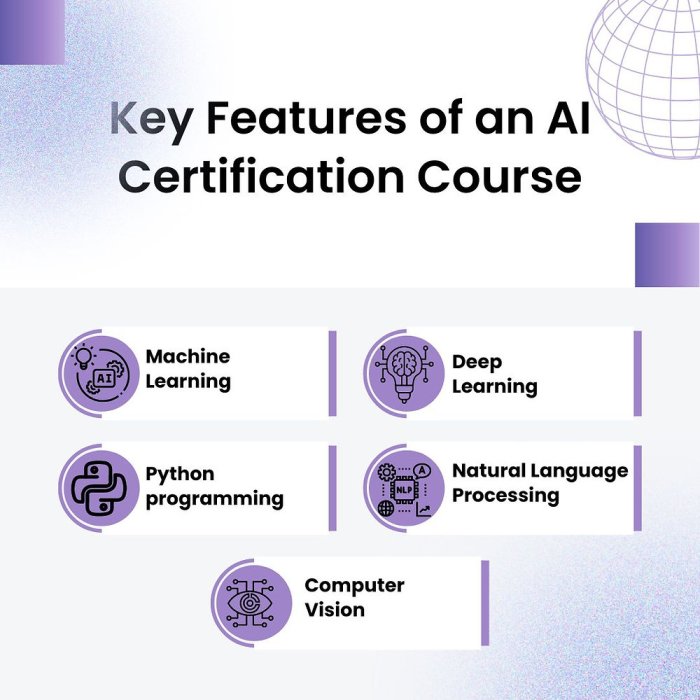
A well-rounded AI certification course encompasses a variety of essential topics that are crucial for anyone looking to enter the field of artificial intelligence. The subjects typically covered include:
- Introduction to Artificial Intelligence: An overview of AI, its history, and its applications in various industries.
- Machine Learning: Focus on supervised, unsupervised, and reinforcement learning, including algorithms like linear regression and decision trees.
- Deep Learning: Exploration of neural networks, convolutional networks for image processing, and recurrent networks for sequence data.
- Natural Language Processing (NLP): Techniques for interaction between computers and humans using natural language, including sentiment analysis and language translation.
- Data Preparation and Exploratory Data Analysis: Methods for cleaning, preparing, and visualizing data to extract insights.
- AI Ethics and Regulations: Discussions on the ethical implications of AI, including bias, accountability, and privacy concerns.
Each of these topics builds upon the last, creating a robust framework for understanding and applying AI techniques effectively in real-world scenarios.
Importance of Hands-on Projects in AI Learning
Hands-on projects form a fundamental component of the AI learning process, allowing learners to apply theoretical knowledge in practical settings. Engaging in real-world projects enables students to develop a deeper understanding of concepts, improve problem-solving skills, and gain valuable experience that is attractive to potential employers. The integration of project-based learning in AI courses can take several forms, such as:
- Building Machine Learning Models: Students create and train models on datasets, enhancing their understanding of model selection and evaluation metrics.
- NLP Applications: Developing chatbots or text analysis tools to solve specific problems, demonstrating the practical use of NLP techniques.
- Image Recognition Projects: Implementing convolutional neural networks on image datasets to classify and recognize images, showcasing the application of deep learning.
- Data Analysis Projects: Conducting exploratory data analysis on real datasets, fostering the ability to draw insights and make data-driven decisions.
Engaging in these projects not only reinforces the learning experience but also prepares students for challenges they will face in the workplace.
Hands-on projects are essential for bridging the gap between theory and practice, providing students with the skills and confidence needed to tackle real-world AI problems.
Skills Acquired Through AI Certification
The AI certification program equips learners with a broad spectrum of skills that are essential in the rapidly evolving landscape of technology. These skills not only enhance technical capabilities but also foster personal development, making participants more well-rounded professionals.
Technical Skills Gained from AI Certification
Participants of an AI certification course acquire a variety of technical skills that are directly applicable in real-world scenarios. These include:
- Machine Learning Algorithms: A deep understanding of various algorithms such as linear regression, decision trees, and neural networks enables professionals to create predictive models.
- Data Analysis: Proficiency in tools like Python, R, and SQL allows for effective data manipulation, analysis, and visualization, which are critical in generating insights from large data sets.
- Deep Learning: Knowledge in frameworks like TensorFlow and PyTorch empowers learners to build and train complex models that can recognize patterns in data.
- Natural Language Processing (NLP): Skills in NLP facilitate the development of applications that understand and generate human language, enhancing user experience in various software solutions.
- Computer Vision: Understanding of image processing techniques and tools enables the construction of systems that can interpret visual information from the world.
These technical skills are pivotal in effectively solving complex problems and innovating in various industries, paving the way for career advancement and opportunities.
Soft Skills Developed During the Course
In addition to technical expertise, AI certification also hones several soft skills that are vital for collaboration and effective communication in the workplace. These skills include:
- Critical Thinking: Analyzing data and forming conclusions enhances decision-making processes.
- Problem-Solving: The capability to approach challenges systematically is cultivated through practical projects during the course.
- Collaboration: Working on group projects fosters teamwork and communication skills, essential for success in diverse work environments.
- Adaptability: The dynamic nature of AI technology encourages professionals to stay agile and open to new methodologies and tools.
- Time Management: Balancing different aspects of coursework helps individuals refine their ability to prioritize tasks effectively.
These soft skills complement technical training, enabling certified professionals to engage effectively with their teams and stakeholders.
Comparison of Skill Set: Certified vs. Non-Certified Individuals
The skill set of individuals who have completed AI certification programs distinctly differs from those who have not undergone formal training. Certified professionals typically possess a more robust understanding of complex AI concepts and tools, as highlighted below:
- Depth of Knowledge: Certified individuals demonstrate a thorough comprehension of AI principles and methodologies, while non-certified individuals may only have superficial knowledge.
- Project Experience: The hands-on projects included in certification programs provide practical experience that non-certified individuals often lack.
- Industry Relevance: Certifications are regularly updated to reflect current trends and technologies, ensuring certified individuals are equipped with up-to-date skills.
- Networking Opportunities: Certification programs often offer access to a network of professionals and mentors, which can significantly enhance career prospects compared to non-certified peers.
The distinct advantages that certified professionals hold make them more competitive in the job market, ultimately leading to better career opportunities and advancements.
Evaluating Course Quality
Choosing the right AI course can significantly impact your learning experience and career trajectory. With a myriad of options available online, it’s crucial to assess the quality and credibility of these courses before committing your time and resources. Evaluating course quality involves understanding the essential factors that contribute to a fruitful learning environment.When selecting an AI course, various factors play a pivotal role in determining its overall quality.
These factors help ensure that the course meets your personal learning goals and aligns with industry standards.
Factors in Selecting an AI Course
Several criteria can help gauge the course quality effectively. These factors generally include the course content, the expertise of the instructors, and the learning format.
- Course Content: Analyze whether the syllabus covers fundamental AI concepts and advanced topics relevant to your interests and career goals.
- Instructor Expertise: Look for courses taught by seasoned professionals with practical experience and recognized credentials in the field of AI.
- Learning Format: Determine if the course format (e.g., self-paced, live lectures) suits your learning style and schedule.
- Hands-on Projects: Courses that include practical assignments or projects offer valuable experience that can enhance your understanding of real-world applications.
Checklist for Evaluating Course Credibility and Reviews
Utilizing a checklist for assessing course credibility can streamline your decision-making process. The following points are vital to consider:
- Accreditation: Verify if the course is accredited by reputable organizations, which can add validity to your learning experience.
- Student Reviews: Look for testimonials and reviews from past students to gauge their satisfaction and learning outcomes.
- Course Updates: Ensure that the course content is regularly updated to reflect the latest trends and advancements in AI.
- Support and Resources: Evaluate the availability of resources, such as access to forums, mentorship, and additional learning materials.
Importance of Industry Recognition and Accreditation
Industry recognition and accreditation are critical components that not only enhance the perceived value of the course but also influence your professional credibility.
“Courses with industry recognition often provide learners with a competitive edge in the job market.”
Courses that are recognized by industry leaders or accredited by established educational institutions can validate your efforts and achievements. Employers frequently look for candidates with credentials from reputable programs, as these signify a certain level of expertise and dedication.Incorporating accredited programs into your learning journey can thus serve as a valuable asset, making you more attractive to potential employers and increasing your opportunities for advancement in the AI field.
Cost and Investment
Investing in an online AI certification course can yield significant returns in terms of career advancement and skill enhancement. However, understanding the costs involved is crucial for prospective learners. This section delves into the average expenses associated with these courses, explores financial aid options, and provides a comparative analysis of costs across various platforms.
Average Costs of Online AI Certification Courses
The cost of online AI certification courses can vary widely based on factors such as the provider, course duration, and the depth of content offered. Generally, learners can expect to pay anywhere from $100 to $3,000 for a certification program. Short introductory courses may cost around $100 to $500, while more comprehensive programs from well-known universities or organizations can range from $1,000 to $3,000.
Investing in a high-quality certification can enhance employability and salary potential significantly.
Financial Aid Options Available for Learners
Many online education platforms recognize the financial challenges learners may face, which is why they offer various financial aid options. Potential avenues for support include scholarships, payment plans, and income share agreements. For instance, platforms like Coursera and edX provide financial aid applications for eligible students, allowing them to access courses at reduced rates. Additionally, some organizations may offer grants or sponsorships for learners who demonstrate financial need or are looking to upskill in AI for career advancement.
Comparison of Course Costs Across Various Platforms
Understanding the price differences among various online education platforms can help learners make informed decisions. Below is a comparison table outlining some popular courses and their associated costs:
| Platform | Course Title | Cost |
|---|---|---|
| Coursera | AI For Everyone | $49/month |
| edX | MicroMasters in Artificial Intelligence | $1,350 |
| Udacity | AI Programming with Python Nanodegree | $399/month |
| LinkedIn Learning | Become an AI Engineer | $29.99/month |
This table highlights the diversity in pricing and course offerings, providing learners with a clear view of their options when considering a certification in artificial intelligence.
Career Opportunities Post-Certification
The field of artificial intelligence (AI) continues to expand rapidly, presenting numerous career opportunities for those who have completed an AI certification course. As organizations increasingly recognize the value of AI in driving innovation and efficiency, certified professionals are in high demand across various industries. This section Artikels potential job roles, salary expectations, and inspiring success stories that highlight the impact of AI certification on career advancement.
Job Roles for AI Certification Graduates
Certified AI professionals can pursue a diverse range of job roles, each with distinct responsibilities and skill requirements. The following list Artikels some of the most sought-after positions in the AI job market:
- Machine Learning Engineer: These professionals design and implement machine learning algorithms to improve systems and processes.
- Data Scientist: Data scientists analyze complex data sets to derive actionable insights, using statistical techniques and machine learning.
- AI Research Scientist: Research scientists focus on advancing AI technology through research and development, often publishing their findings in academic journals.
- AI Product Manager: Product managers oversee the development and launch of AI products, ensuring they meet market needs and business goals.
- Robotics Engineer: Robotics engineers design and build robotic systems that can perform tasks autonomously, often leveraging AI technologies.
- AI Consultant: Consultants advise organizations on how to implement AI solutions effectively to improve operations and achieve strategic objectives.
Salary Expectations for Certified AI Professionals
The financial rewards for certified AI professionals are significant, with salary expectations varying based on experience, location, and industry. Typically, AI certification holders can anticipate competitive salaries that reflect their specialized skills. For example:
- Machine Learning Engineers can earn between $110,000 and $160,000 annually, depending on their expertise and the complexity of projects.
- Data Scientists often command salaries ranging from $100,000 to $150,000, with top earners exceeding this range in tech hubs.
- AI Research Scientists typically make between $120,000 and $180,000, particularly if they are affiliated with major research institutions or tech companies.
According to a report from the AI Workforce Institute, job postings for AI roles have surged by over 74% in the past year, indicating robust demand for certified professionals.
Success Stories of Career Advancement
Numerous individuals have transformed their careers after obtaining AI certification, leading to remarkable professional growth. Here are a few notable examples:
- Jane Doe transitioned from a traditional IT role to a Machine Learning Engineer position at a leading tech firm, increasing her salary by 40% within a year of certification.
- John Smith, previously a data analyst, leveraged his AI certification to become a Data Scientist, contributing to high-profile projects that improved company performance and boosted his visibility in the industry.
- Emily Johnson, after completing her certification, started her own AI consulting firm, helping businesses implement AI solutions effectively, which has since grown into a six-figure income venture.
Resources for Further Learning

To deepen your understanding of artificial intelligence beyond the course, a variety of resources are available that cater to different learning styles and preferences. Whether you prefer reading books, engaging in online discussions, or listening to informative podcasts, there’s something for everyone. This section highlights some of the best materials and platforms to help you continue your AI journey.
Recommended Books and Articles on AI
Exploring literature on artificial intelligence can provide profound insights and advanced knowledge. The following are some highly regarded books and articles that cover a wide array of AI topics, from foundational concepts to advanced techniques.
- “Artificial Intelligence: A Modern Approach” by Stuart Russell and Peter Norvig – This comprehensive textbook is often referred to as the “bible” of AI, covering a broad spectrum of topics with clarity and depth.
- “Deep Learning” by Ian Goodfellow, Yoshua Bengio, and Aaron Courville – A definitive guide that delves into deep learning techniques and theories, making it an essential read for aspiring data scientists.
- “Superintelligence: Paths, Dangers, Strategies” by Nick Bostrom – This thought-provoking book examines the future of AI and the potential risks associated with superintelligent systems.
- “The Master Algorithm” by Pedro Domingos – A fascinating exploration of machine learning techniques and the quest for a universal algorithm.
- Research Articles
-Keeping up with the latest research through journals like the Journal of Artificial Intelligence Research or reading articles on platforms such as arXiv can enhance your knowledge of cutting-edge developments.
Online Communities and Forums for Ongoing Support
Engagement with online communities can facilitate knowledge exchange and provide support as you navigate your AI learning path. Here are some notable communities:
- Reddit
-Subreddits like r/MachineLearning and r/ArtificialIntelligence are vibrant spaces for sharing news, projects, and discussions. - Stack Overflow
-A crucial platform for asking questions and receiving answers from experienced practitioners in the AI and programming fields. - AI Alignment Forum
-Focused on discussions around the alignment problem in AI, this forum is excellent for those interested in the ethical implications of AI. - Kaggle
-A community for data science and machine learning enthusiasts where you can participate in competitions and share projects. - LinkedIn Groups
-Joining AI-related groups on LinkedIn can connect you with professionals and companies active in the field.
Additional Online Resources: Webinars and Podcasts, Artificial Intelligence Course Online Certification
Webinars and podcasts are fantastic ways to learn from experts while on the go. Here are some excellent resources to consider:
- AI Alignment Podcast
-Focuses on the nuances of AI alignment and related ethical questions featuring expert guests. - The TWIML AI Podcast
-Covers a range of topics in machine learning and AI through interviews with industry leaders. - Data Skeptic
-A podcast that breaks down complex AI concepts into understandable segments, perfect for beginners. - Webinars by AI organizations
-Organizations like the Association for the Advancement of Artificial Intelligence (AAAI) regularly host webinars on various AI topics. - Coursera and edX
-These platforms offer free webinars and courses from top universities, covering both introductory and advanced AI topics.
Ultimate Conclusion
In conclusion, pursuing an Artificial Intelligence Course Online Certification not only enhances your skill set but also opens up a multitude of career opportunities. With the demand for AI professionals on the rise, this certification serves as a launching pad for those looking to make significant strides in their careers. Embrace the journey of learning and let this course be your guide in the transformative world of artificial intelligence.
Essential FAQs
What prerequisites do I need for the course?
Basic understanding of programming and statistics is recommended but not mandatory.
How long does it take to complete the certification?
Typically, it takes around 3 to 6 months, depending on the pace of learning.
Will I receive assistance during the course?
Yes, most platforms offer support through forums and direct communication with instructors.
Is the certification recognized by employers?
Yes, industry recognition varies by course, so it’s important to choose accredited programs.
Can I access course materials after completion?
Many platforms allow continued access to materials even after certification is awarded.

I am a professional writer with more than a decade of experience in creative and educational writing. Since the beginning of my career, I have been dedicated to developing works that are not only informative but also capable of providing deep understanding for readers from various backgrounds.